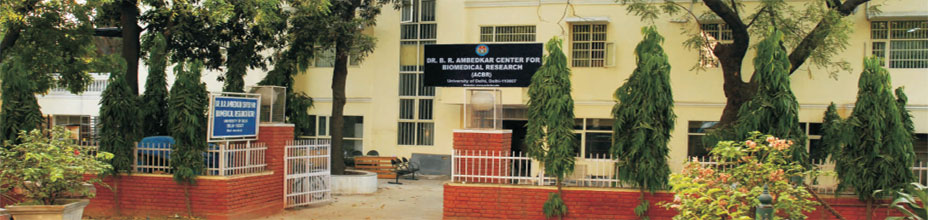
Ordiance
Ordinance - M.Sc-Ph.D Combined Degree Programme in Biomedical Sciences
Excerpts from the ordinance of M.Sc. (Master of science) in Biomedical Sciences and M.Sc. –Ph.D. Combined programme in Biomedical Sciences at Dr. B. R. Ambedkar Center for Biomedical Research, University of Delhi.
M.Sc. (MASTER OF SCIENCE) in Biomedical Sciences and M.Sc. Ph.D. Combined Programme in Biomedical Sciences at Dr. B. R. Ambedkar Center for Biomedical Sciences, University of Delhi was approved by the University through ordinance in 1997/1998 and subsequently with a syllabus revision in 2009 (vide EC resolution No. 99 (14) dated 27 -07 -2009)
A candidate seeking admission to the programme must have passed the bachelor of Science examination in Life Sciences / Zoology / Botany / Microbiology / Chemistry / Biochemistry / Environmental Biology / M. B. B. S. / Biotechnology / Lab Technologies / B. Pham. / and B. V. Sc. Etc. with atleast 55% marks from University of Delhi or any other examination recognized by the University as equivalent therto, and also must possess such other qualification including passing of an entrance examination written and / or practical, and / or oral, as may be prescribed by the Academic Council from time ti time.
Course structure implemented w. e. f. July 2009.
The programme shall be governed by the Dr. B.R. Ambedkar Center for Biomedical Research, Faculty of Science, University of Delhi, Delhi-110 007.
| Semester – Odd | Semester-Even | ||
| Part I | First Year | Semester – I | Semester – II |
| Part II | Second Year | Semester – III | Semester – IV |
Each semester would consist of five papers and one practical through Semester I and II (Part I) and semester III. Semester IV (Part II) would comprise of Optional Papers from which each student has to select two papers and undertake Dissertation work. Selection of papers in Semester IV would be based on merit (performance in the Part I Examinations), choice and other specific guidelines as outlined below. It is mandatory for each student to complete a Dissertation, assigned at the end of 2 nd Semester and complete at the end of 4 th Semester. It would comprise of bench work. The schedule of papers prescribed for various semesters shall be as follows:
CLASSIFICATION OF PAPERSPart I : Semester – I
| S.No. | Code | Subject | Maximum Marks | Credits |
| 1 | MBS 101 | Organic Chemistry-I | 100 | 4 |
| 2 | MBS 102 | Biochemistry | 100 | 4 |
| 3 | MBS 103 | Cell Biology | 100 | 4 |
| 4 | MBS 104 | Medical Microbiology | 100 | 4 |
| 5 | MBS 105 | Genetics | 100 | 4 |
| 6 | MBS 106 | Practicals | 100 | 4 |
|
Total | 600 | 24 | |
Part I : Semester – II
| S.No. | Code | Subject | Maximum Marks | Credits |
| 1 | MBS 201 | Organic Chemistry-II | 100 | 4 |
| 2 | MBS 202 | Molecular Biology and Biotechnology | 100 | 4 |
| 3 | MBS 203 | Application of Statistics & Mathematics for Biology | 100 | 4 |
| 4 | MBS 204 | Immunology | 100 | 4 |
| 5 | MBS 205 | Human Physiology-I | 100 | 4 |
| 6 | MBS 206 | Practicals | 100 | 4 |
|
Total | 600 | 24 | |
Part II : Semester – III
| S.No. | Code | Subject | Maximum Marks | Credits |
| 1 | MBS 301 | Human Physiology-II | 100 | 4 |
| 2 | MBS 302 | Principles of Medicinal Chemistry | 100 | 4 |
| 3 | MBS 303 | Analytical and Biomedical Techniques & Instrumentation | 100 | 4 |
| 4 | MBS 304 | Molecular Oncology | 100 | 4 |
| 5 | MBS 305 | Toxicology & Pharmacology | 100 | 4 |
| 6 | MBS 306 | Practicals | 100 | 4 |
|
Total | 600 | 24 | |
Part II : Semester – IV
| S.No. | Code | Subject | Maximum Marks | Credits |
| 1 | MBS 401 | Dissertation | 400 | 16 |
| 3 | MBS | Special Paper I (Optional) | 100 | 4 |
|
Total | 500 | 20 | |
Special Papers* being offered (based on choice cum merit basis)
| S.No. | Code | Subject | Maximum Marks | Credits |
| 1. | MBS 402 | Genome Biology | Interdisciplinary | Biology |
| 3. | MBS 403 | Concepts in drug discovery and mechanism | Interdisciplinary | Chemistry |
| 2. | MBS 404 | Advanced Medicinal Chemistry | Interdisciplinary | Chemistry |
| 4. | MBS 405 | Radiation Biology | Interdisciplinary | Zoology |
| 5. | MBS 406 | Topics in Clinical Research |
|
|
| 6. | MBS 407 | Advanced Toxicology & Pharmacology |
|
|
| 7. | MBS 408 | Advanced Immunology | Interdisciplinary | Zoology |
SCHEME OF EXAMINATION
| 1. | English shall be the medium of instruction and examination. |
| 2. | Examinations shall be conducted at the end of each semester as per the Academic Calendar notified by the University of Delhi. |
| 3. | Each course will carry 100 marks and will have two components: Internal assessment |
| (30 marks) and end of semester examination (70 marks) |
Theory
| i. | Internal Assessment | 30 marks |
| a. Attendance | 05 marks | |
| b. Test / Assignments | 25 marks | |
| ii. | End of semester examination | 70 marks |
| iii. | End Semester Examination (Practicals) | 100 marks |
| 4. | The system of evaluation shall be as follows: | ||
| 4.1 | Internal assessment will be broadly based on attendance in theory (5 marks), assignments and tests in the theory component (25 marks). These criteria are tentative and could be modified by the faculty members associated with teaching of a paper based on guidelines approved by the academic council. | ||
| 4.2 | The scheme of evaluation for dissertation shall be as follows: | ||
| 4.2.1 | Dissertation will formally begin from end of Semester II and will consist of bench work. | ||
| 4.2.2 | Dissertation work will consist of internal evaluation by the concerned supervisor based on general performance, written assignments, student seminar, in-class examination during the duration of the dissertation (100 marks), Project work (200 marks) and viva-voce (100 marks) the last two being evaluated by a board comprising of all teachers in the Department and /or external experts. | ||
| 5. | Examinations for courses shall be conducted only in the respective odd and even Semester as per the Scheme of Examinations. Regular as well as Ex-students shall be permitted to appear / re-appear / improve in courses of Odd Semesters only at the end of Odd Semesters and courses of Even-Semesters only at the end of Even Semesters. | ||
PASS PERCENTAGE
Minimum marks for passing the examination in each semester shall be 40% in each paper and 45% in aggregate of a semester.
However, a candidate who has secured the minimum marks to pass in each paper but has not secured the minimum marks to pass in aggregate may reappear in any of the paper/s of his choice in the concerned semester in order to be able to secure the minimum marks prescribed to pass the semester in aggregate.
No student would be allowed to avail of more than two chances to pass a paper inclusive of the first attempt.
PROMOTION CRITERIASemester to Semester:
Students shall be required to fulfil the Part to part Promotion Criteria. Within the same part, students shall be promoted from a semester to the next semester, provided she/he has passed at least three out of the five theory examinations of the current semester. However passing in practical is mandatory for promotion from one semester to next. There shall not be any repeat/improvement allowed for practical examination.
Part I to Part II :Admission to Part II of the programme shall be open to only those students who have successfully passed at least 6 theory papers out of papers offered for the Part I courses comprising of Semester-I and Semester-II taken together and two practical papers. However, she/he will have to clear the remaining papers while studying in Part-II of the programme.
DIVISION CRITERIASuccessful candidates will be classified on the basis of combined results of Part-I and Part-II examinations as follows:
Candidates securing 60% and above : I Division
Candidates securing between 50% and 59.99% : II Division
All others between 40-49.99% : Pass
QUALIFYING PAPERSNone
SPAN PERIODNo students shall be admitted as a candidate for the examination for any of the Parts/Semesters after the lapse of four years from the date of admission to the Part-I/Semester-I of the M.Sc. in Biomedical Programme.
ATTENDANCE REQUIREMENTNo student shall be considered to have pursued a regular course of study unless he/she is certified by the Head /Director of the Dr. B.R. Ambedkar Center for Biomedical Research, University of Delhi, to have attended 75% of the total number of lectures and seminars conducted in each semester, during his/her course of study. Provided that he/she fulfils other conditions, the Head/Director, Dr. B.R. Ambedkar Center for Biomedical Research may permit a student to the next Semester who falls short of the required percentage of attendance by not more than 10% of the lectures and seminars conducted during the Semester.
Ph.D. ProgrammeAdmission to the Ph.D. programme at Dr. B.R. Ambedkar Centre for Biomedical Research is through two streams.
The students from M.Sc.- Ph.D. Combined programme in Biomedical Sciences.
Students who have completed M.Sc. in any discipline of life sciences or chemistry from Delhi University or any other UGC approved University.
EligibilityM.Sc.-Ph.D. Combined Programme students should have minimum of 55% marks in aggregate(?) and candidates who have qualified any one of the National level examinations for the award of Junior Research fellowship will be preferred. Admission to the Ph.D. programme is subjected to qualifying the interview conducted by the selection committee appointed by the Director of Dr. B.R. Ambedkar Centre for Biomedical Research.
Thesis RequirementEach doctoral student must complete the results of extended research and make an original contribution to the field. This work should give evidence of the candidate's ability to conduct independent investigation and to interpret the results in an acceptable manner.
The thesis advisor (two co-advisor for the interdisciplinary option, described next) serves as chairman of the thesis committee, which consists of no fewer than six members appointed by the Director of the program. The selection of an advisor is by mutual consent of the student and a member of the faculty, with the approval of the Director. At least two members of the committee must be faculty members of the University, and at least one member must be from outside the Department. To ensure high quality of the thesis, the Director of the program may appoint additional outside referees or experts. Individuals are chosen for their expertise in the area of research under evaluation. The student's research progress will be evaluated by this advisory committee, which meets no less than once a year; at each meeting the student presents both a written and an oral progress report. Low productivity or unsatisfactory work may result in the student's dismissal from the program at any time. A thesis advisor should normally be selected within four months of joining the course and the student is expected to begin research and demonstrate satisfactory proficiency in the laboratory.
Interdisciplinary OptionAn interdisciplinary option is available to the students in the Biomedical Science M.Sc-Ph.D. program. The option is intended to meet the needs of students interested in combining courses and skills from two areas of specialization. At least on of the specialization areas selected must come from within the center. The second area may come from another department or Institute, such as Biology, Chemistry, or Engineering etc. Thesis co advisors are arranged for student who select this option. Students may begin to consider its option by discussing it with a faculty member in the Center who represents on of their areas of interest and by informing the M.Sc-Ph.D Program Director's office.
The two areas of academic concentration are reflected in the course work, cumulative exams, and thesis work undertaken. Students take the required course, and the remaining courses will be selected with the help and approval of the co advisors. Students selecting the interdisciplinary option must fulfill the same requirements as all other Ph.D candidates and will be governed by the ordinance VI-B of the University.
Research proposal defence. After completing the qualifying examination, student with the approval of the advisory committee or thesis committee, will prepare a written proposal and defend it orally before the committee before submitting the synopsis of the thesis of the committee of courses. The signed proposal from should be submitted to the Ph.D program Director's office.
Thesis DefenceThe final oral examination will be taken after the completion of all other requirements for the degree. The examinations deals with the subject matter of the Doctoral dissertation, significant developments in the field of the thesis, and the student's background knowledge in the field of specialization. The thesis committee will conduct the final oral examination. The Director of the Biomedical Science M.Sc-Ph.D program, in consultation with the supervisor may appoint any other additional members considered necessary by this committee.
The award of the degree of Doctor of Philosophy shall be granted in the M.Sc-Ph.D combined programme of Dr. B.R. Ambedkar Center for Biomedical Research according to the Ordinance VI.B of the University of Delhi.
Ordinance XV - BMaintenance of discipline among s tudents of the University
| 1. | All powers relating to discipline and disciplinary action are vested in the Vice-Chancellor. |
|
| 2 | The Vice-Chancellor may delegate all or such powers, as he/she deems proper to the Proctor and to such other persons as he/she may specify in this behalf. |
|
| 3. | W ithout prejudice to the generality of power to enforce discipline under the Ordinance the following shall amount to acts of gross indiscipline: |
|
a. |
Physical assault or threat to use physical force, against any member of teaching and non-teaching staff of any Institution / Department and against any student within the University of Delhi. |
|
b. |
Carrying of, use of or threat to use of any weapons. |
|
c. |
Any violation of the provisions of the Civil Rights Protection Act, 1976. |
|
d. |
Violation of the status, dignity and honour of students belonging to the Scheduled castes or tribes. |
|
e. |
Any practice-whether verbal or otherwise-derogatory of women. |
|
f. |
Any attempt at bribing or corruption in any manner. |
|
g. |
Wilful destruction of institutional property. |
|
h. |
Creating ill-will or intolerance on religious or communal grounds. |
|
i. |
Causing disruption in any manner of the academic functioning of the University system. |
|
j. |
Ragging as per Ordinance XV-C. |
|
| 4. | Without prejudice to the generality of his/her powers relating to the maintenance of discipline and taking such action in the interest of maintaining discipline as may seem to him/her appropriate, the Vice-Chancellor, may in the exercise of his/her powers aforesaid order or direct that any student or students- |
|
a. |
be expelled. |
|
b. |
be, for a stated period rusticated. |
|
c. |
be not for a stated period, admitted to a course or courses of study in a College, Department or Institution of the University. |
|
d. |
be fined within a sum of rupees that may be specified. |
|
e. |
be debarred from taking a University or College or departmental Examination or Examinations for one or more years . |
|
f. |
the result of the student or students concerned in the Examination or Examinations in which he/she or they have appeared be cancelled. |
|
| 5. | The Principals of the Colleges, Heads of the Halls, Deans of Faculties, Heads of Teaching Departments in the University, the Principal, School of Open Learning and Librarians shall have the authority to exercise all such disciplinary powers over students in their respective Colleges, Institutions, Faculties and Teaching Departments in the University as may be necessary for the proper conduct of Institutions, h alls and teaching in the concerned d epartments. They may exercise their authority to such of the teachers in their Colleges, Institutions or Departments as they may specify for these purposes. |
|
| 6. | Without prejudice to the powers of the Vice-Chancellor and the Proctor as aforesaid detailed rules of discipline and proper conduct shall be framed. Theses rules may be supplemented, where necessary, by the Principals of Colleges, h eads of h alls, Deans of Faculties and Heads of Teaching Departments in this University. Each students shall be expected provide himself/ herself with a copy of these rules. The time of admission, every student shall be required to sign a declaration that on admission he/she submits himself/ herself to the disciplinary jurisdiction of the Vice-Chancellor and several authorities of the University who may be vested with the authority to exercise discipline under the Acts, the Statutes, the Ordinances and the rules that have been framed therein by the University. |
|
Ordinance XV - C
Prohibition and Punishment for Ragging
| 1. | Ragging in any form is strictly prohibited, within the premises of College/Department or Institution and any part of Delhi University system as well as on public transport. |
|
| 2. | Any individual or collective act or practice or ragging constitutes gross indiscipline and shall be dealt with under this Ordinance. |
|
| 3. | Ragging for the purpose of this Ordinance, ordinarily means any act, conduct or practice by which dominant power or status of senior students is brought to bear on students freshly enrolled or students who are in any way considered junior or inferior by other students; and includes individual or collective acts or practices which- |
|
a. |
involve physical assault or threat to use of physical force |
|
b. |
violate the status, dignity and honour of women students |
|
c. |
violate the status, dignity and honour of women students |
|
d. |
expose students to ridicule and contempt and affect their self-esteem |
|
e. |
entail verbal abuse and aggression, indecent gestures and obscene behavior. |
|
| 4. | The Principal of a College, the Heads of the Department or an Institution, the authorities of College, or University Hostel or Halls of r esidence shall take immediate action on nay information of the occurrence of ragging. | |
| 5. | Notwithstanding anything in Clause (4) above, the p roctor may also suo moto enquire into any incident of ragging and make a report to the Vice-Chancellor of the identity of those who have engaged in ragging and the nature of the incident. |
|
| 6. | The Proctor may also submit an initial report establishing the identity of the perpetrators of ragging and the nature of the ragging incident. |
|
| 7. | If the Principal of a College or Head of the Department or Institution or the Proctor is satisfied that for some reasons, to be recorded in writing., it is not reasonably practical to hold such an enquiry, he/she may so advise the Vice-Chancellor accordingly. |
|
| 8. | When the Vice-Chancellor is satisfied that it is not expedient to hold such an enquiry, his/her decision shall be final. |
|
| 9. | On the receipt of a report under Clause (5) or (6) or a determination by the relevant authority under Clause (7) disclosing the occurrence of ragging incidents described in Clause 3(a), (b) and (c), the Vice-Chancellor shall direct or order rustication of a student or students for a specific number of years. |
|
| 10. | The Vice-Chancellor may in other cases of ragging order or direct that any student or students be expelled or be not for a stated period, admitted to a course of study in a college, departmental examination for one or more year or that the results of the student or students concerned in the examination or examinations in which they appeared be cancelled. |
|
| 11. | In case any students who have obtained degrees or diplomas of Delhi University are found guilty; under this Ordinance, appropriate action will be taken under Statute 15 for withdrawal of degrees or diplomas conferred by the University. |
|
| 12. | For the purpose of this Ordinance, abetment to ragging whether by way of any act, practice incitement of ragging will also amount to ragging. |
|
| 13. | All Institutions within the Delhi University system shall be obligated to carry out instructions/ directions issued under this Ordinance, and to give aid assistance to the Vice-Chancellor to achieve the affective implementation of the Ordinance. |
|
Note: Order of the Vice-Chancellor in pursuance of Ordinance XV-C
Where incidents(s) of ragging are reported to the Vice-Chancellor by any authority under this o rdinance, the students(s) involved in ragging, shall be expelled for a specified term, designated in the order, non-students involved in report of ragging will be proceeded with under the criminal law of India; t hey will also be rendered ineligible for a period of five years from seeking enrolment in any of the institutions of the University of Delhi. Students against whom necessary action is taken under this note, will be given post decisional hearing, with strict adherence to the rules of natural justice.